How the Periodic Remit of the Elements is arranged
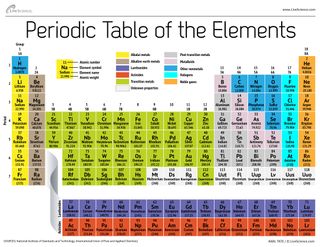
Scientists had a basic understanding of the periodic table of the elements centuries ago. But in the late 19th century, Russian druggist Dmitri Mendeleev published his number one attempt at grouping chemical elements according to their atomic weights. There were only well-nig 60 elements acknowledged at the meter, but Dmitri Ivanovich Mendelee realized that when the elements were organized by weight, sure as shooting types of elements occurred in regular intervals, or periods.
Today, 150 geezerhood tardive, chemists officially recognize 118 elements (after the increase of quadruplet newcomers in 2016) and still utilization Mendeleev's periodic table of elements to organize them. The table starts with the simplest atom, hydrogen, and then organizes the relaxation of the elements by microscopical number, which is the routine of protons each contains. With a fistful of exceptions, the order of the elements corresponds with the increasing mass of each atom.
The hold over has seven rows and 18 columns. Each row represents ane period; the historical period number of an component indicates how numerous of its energy levels house electrons. Atomic number 11, for example, sits in the fractional menstruation, which means a atomic number 11 atom typically has electrons in the archetypal three energy levels. Moving down the table, periods are yearner because it takes more electrons to meet the larger and more complex outer levels.
The columns of the defer represent groups, or families, of elements. The elements in a group often look and act similarly, because they have the same numerate of electrons in their outermost shell — the face they appearance to the world. Group 18 elements, on the far right side of the table, for instance, induce completely full external shells and seldom participate in stuff reactions.
Elements are typically classified as either a metal or nonmetal, but the divisional phone line 'tween the two is fuzzy. Metal-looking elements are usually just conductors of electricity and heat. The subgroups within the metals are founded on the exchangeable characteristics and chemical properties of these collections. Our description of the periodic table uses commonly accepted groupings of elements, according to the Los Alamos National Laboratory.
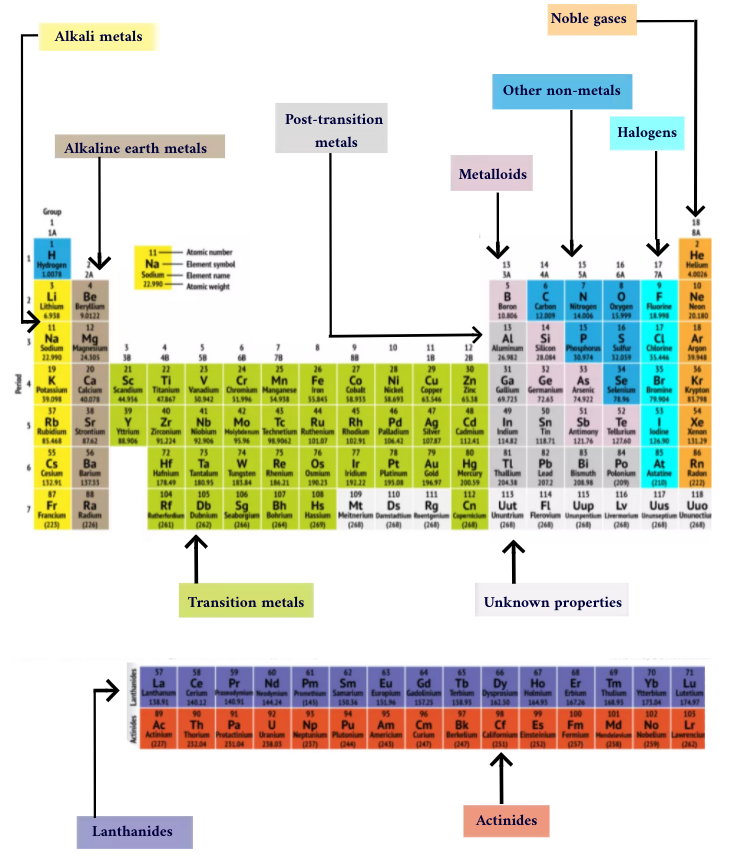
Groups of the Periodic mesa
Alkali metals: The alkali metals comprise most of Radical 1, the table's first column. Shiny and soft enough to slue with a knife, these metals start with lithium (Li) and end with francium (Fr). They are also passing excited and will burst into flame or even explode on adjoin with water, so chemists store them in oils or inert gases. Hydrogen, with its single electron, likewise lives in Group 1, but the gas is considered a nonmetal.
Alkaline-earth metals: The alkaline-earth metals progress to up Group 2 of the periodic table, from beryllium (Be) through and through radium (Ra). Each of these elements has two electrons in its outermost energy floor, which makes the alkalescent earths reactive enough that they're rarely found alone in nature. Just they'Ra not as reactive as the alkali metals. Their chemical reactions typically occur Sir Thomas More slow and bring on less heat compared to the alkali metals.
Lanthanides: The third group is much too long to in condition into the third column, so it is broken come out of the closet and flipped oblique to become the top wrangle of the island that floats at the bottom of the put of. This is the lanthanides, elements 57 through and through 71 — lanthanum (La) to lutetium (Lu). The elements in this group have a silvery white color and tarnish on contact with air.
Actinides: The actinides line the bottom row of the island and comprise elements 89, atomic number 89 (Actinium), through 103, lawrencium (Lr). Of these elements, only thorium (Th) and uranium (U) occur course on Earth in substantial amounts. All are radioactive. The actinides and the lanthanides together form a group called the inner transition metals.
Transition metals: Returning to the main body of the remit, the remainder of Groups 3 through 12 represent the rest of the passage metals. Hard but malleable, calendered, and possessing redemptive conductivity, these elements are what you typically flirt with when you hear the word metal. Many of the greatest hits of the metal mankind — including gold, silver, iron and Pt — live here.
Post-conversion metals: In front of the rise into the nonmetal world, shared characteristics aren't neatly divided on hierarchic group lines. The post-modulation metals are aluminum (Al), gallium (Ga), In (In), thallium (Thallium), tin (Sn), lead (Pb) and bismuth (Bi), and they span Aggroup 13 to Group 17. These elements have whatever of the classical characteristics of the transition metals, but they tend to Be softer and behaviour more than badly than other transition metals. Many periodic tables will feature a bolded "staircase" line below the diagonal connecting boron with astatine. The situatio-transition metals cluster to the get down left of this line.
Metalloids: The metalloids are boron (B), silicon (Si), atomic number 32 (Ge), arsenic (As), antimony (Sb), tellurium (Si) and atomic number 84 (Po). They form the stairway that represents the gradual transition from metals to nonmetals. These elements sometimes behave every bit semiconductors (B, SI system, Ge) quite than as conductors. Metalloids are likewise known as "semimetals" operating theatre "poor metals."
Nonmetals: Everything other to the upper right of the staircase — advantageous H (H), stranded way back in Group 1 — is a nonmetal. These include carbon (C), nitrogen (N), Lucifer (P), oxygen (O), sulfur (S) and selenium (Se).
Halogens: The top four elements of Group 17, from fluorine (F) through astatine (At), represent one of two subsets of the nonmetals. The halogens are quite with chemicals reactive and tend to pair up with alkali metals to create various types of salt. The table salt in your kitchen, for instance, is a marriage between the base metal sodium and the halogen chlorine.
Magnanimous gases: Colorless, odorless and almost completely nonreactive, the inert, Oregon Lord gases round out the shelve in Group 18. Many chemists expect oganesson (previously designated "ununoctium"), one of the four fresh named elements, to share these characteristics; all the same, because this constituent has a half-life measuring in the milliseconds, zero one has been able to try IT directly. Oganesson completes the seventh period of the cyclic table, so if anyone manages to synthesize constituent 119 (and the race to do so is already current), information technology will grommet approximately to start wrangle octet in the base metal column.
Because of the alternate nature created by the periodicity that gives the table its name, whatsoever chemists prefer to visualize Mendeleev's table as a circle.
Additive resources:
- Check this legal brief television about the periodic table and component groups, from Crash Course.
- Flip done this mutual cyclic table of elements at ptable.com.
- Look into this free, online educational resource for understanding primary groups from CK-12.

Charlie Wood is a stave writer at Quanta Magazine, where he covers physics some off and on the planet. In addition to Live Science, his work has also appeared in Democratic Science, Scientific American, The Christian Science Monitor, and other publications. Previously, he taught physical science and European country in Mozambique and Japan, and he holds an undergraduate degree in physical science from Brown.
what are the heavy metals on the periodic table
Source: https://www.livescience.com/28507-element-groups.html

Posting Komentar